INTRODUCTION
One of the first questions asked by a new CAT aspirant is: What exactly should I study for CAT?
Unlike many university examinations, CAT does not provide candidates with a detailed chapter-by-chapter syllabus listing every possible topic.
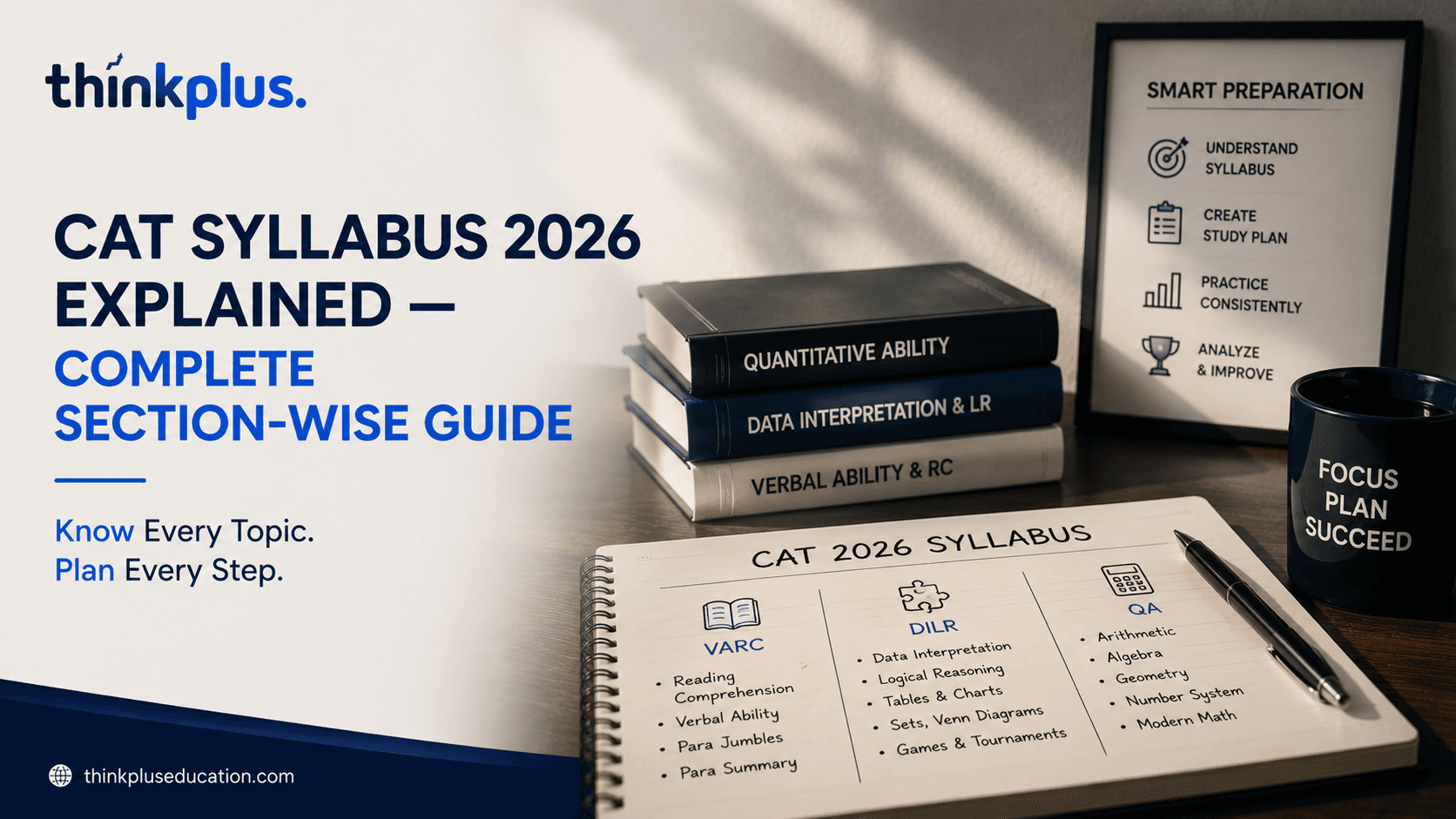
The practical CAT syllabus is therefore understood through the three established sections of the examination and the types of questions repeatedly seen in recent papers.
Those three areas are: Verbal Ability and Reading Comprehension (VARC) Data Interpretation and Logical Reasoning (DILR) Quantitative Ability (QA)
Recent CAT papers have used strict sectional timing, so preparation must be balanced. A very strong score in one section does not automatically compensate for neglecting another when institutes also apply sectional cut-offs.
CAT VARC SYLLABUS
VARC tests comprehension, reasoning and the ability to understand written arguments.
READING COMPREHENSION
RC normally forms the major part of VARC in recent CAT papers.
Passages can come from:
The subject of the passage is less important than your ability to understand it.
Questions may test:
The core skill is reading for structure, not memorising every sentence.
VERBAL ABILITY
Recent CAT papers have included formats such as:
The exact combination can change.
That is why candidates should prepare the broader abilities of: coherence, sequencing, summarisation and logical flow.
CAT DILR SYLLABUS
DILR does not behave like a conventional school syllabus.
A CAT set may combine several ideas at once.
Common preparation categories include:
DATA INTERPRETATION
LOGICAL REASONING
However, studying these labels is not enough.
CAT frequently presents hybrid sets where the difficulty comes from organising information rather than identifying a familiar chapter.
Therefore, practise sets from many years and sources.
DILR success depends on three skills: Representation Set Selection Execution
If you cannot represent information clearly in a table, diagram or concise notation, even an easy set can become confusing.
CAT QUANTITATIVE ABILITY SYLLABUS
QA is more topic-driven than DILR.
A practical CAT Quant syllabus includes the following major areas.
ARITHMETIC
Arithmetic is an excellent starting point because several concepts connect naturally.
ALGEBRA
Algebra has remained an important area across recent CAT papers.
GEOMETRY AND MENSURATION
Geometry rewards conceptual clarity. Drawing the figure correctly is often half the work.
NUMBER SYSTEM
MODERN MATHEMATICS AND OTHER AREAS Depending on how institutes and coaching sources classify questions, this may include:
Do not over-prioritise a topic simply because it has an intimidating name.
HOW SHOULD YOU PRIORITISE THE CAT SYLLABUS?
Divide topics into four categories:
A. High frequency + weak B. High frequency + strong C. Lower frequency + weak D. Lower frequency + strong
Category A deserves the greatest attention.
For VARC and DILR, use skill-based classification rather than chapters.
For example: VARC weakness: inference questions DILR weakness: set selection QA weakness: algebra
This produces a much more useful plan than simply saying, “My DILR is weak.”
DO NOT WAIT TO FINISH THE SYLLABUS BEFORE TAKING TESTS
A common mistake is:
“I will complete the entire CAT syllabus first, then start mocks.”
That delays the development of timed decision-making.
Instead:
Learn → Test → Analyse → Repair → Retest
Start topic tests early. Introduce sectionals while concepts are still being built. Use full mocks once enough of the syllabus is familiar.
HOW MUCH OF THE SYLLABUS MUST YOU MASTER?
CAT does not require you to solve every question.
This changes the way you should think about completion.
Your objective is to create a wide enough skill base to identify and solve the most scoreable questions in the paper.
A student with 80% of the syllabus at high mastery may outperform someone who has “covered” 100% superficially.
CONCLUSION
The CAT syllabus 2026 should be treated as a map, not a checklist.
VARC requires comprehension and verbal reasoning. DILR requires representation, selection and logical execution. QA requires conceptual command across major mathematical families.
Cover the fundamentals, practise mixed questions and allow mock-test data to determine where your next hour of study goes.
CAT is not won by completing the most topics. It is won by converting preparation into marks.
Editorial Reference Basis: Official CAT 2026 information for examination framework; recent CAT papers and established past-paper categories for practical syllabus mapping.
Talk to a Thinkplus counsellor and turn this article into a realistic preparation plan.