INTRODUCTION
Previous-year papers are among the most valuable resources in CAT preparation because they show what no syllabus list can fully explain:
How CAT actually converts concepts into pressure.
A past paper teaches:
But the wrong use of PYQs can create false confidence.
The purpose is not to predict the next paper exactly.
The purpose is to become adaptable.
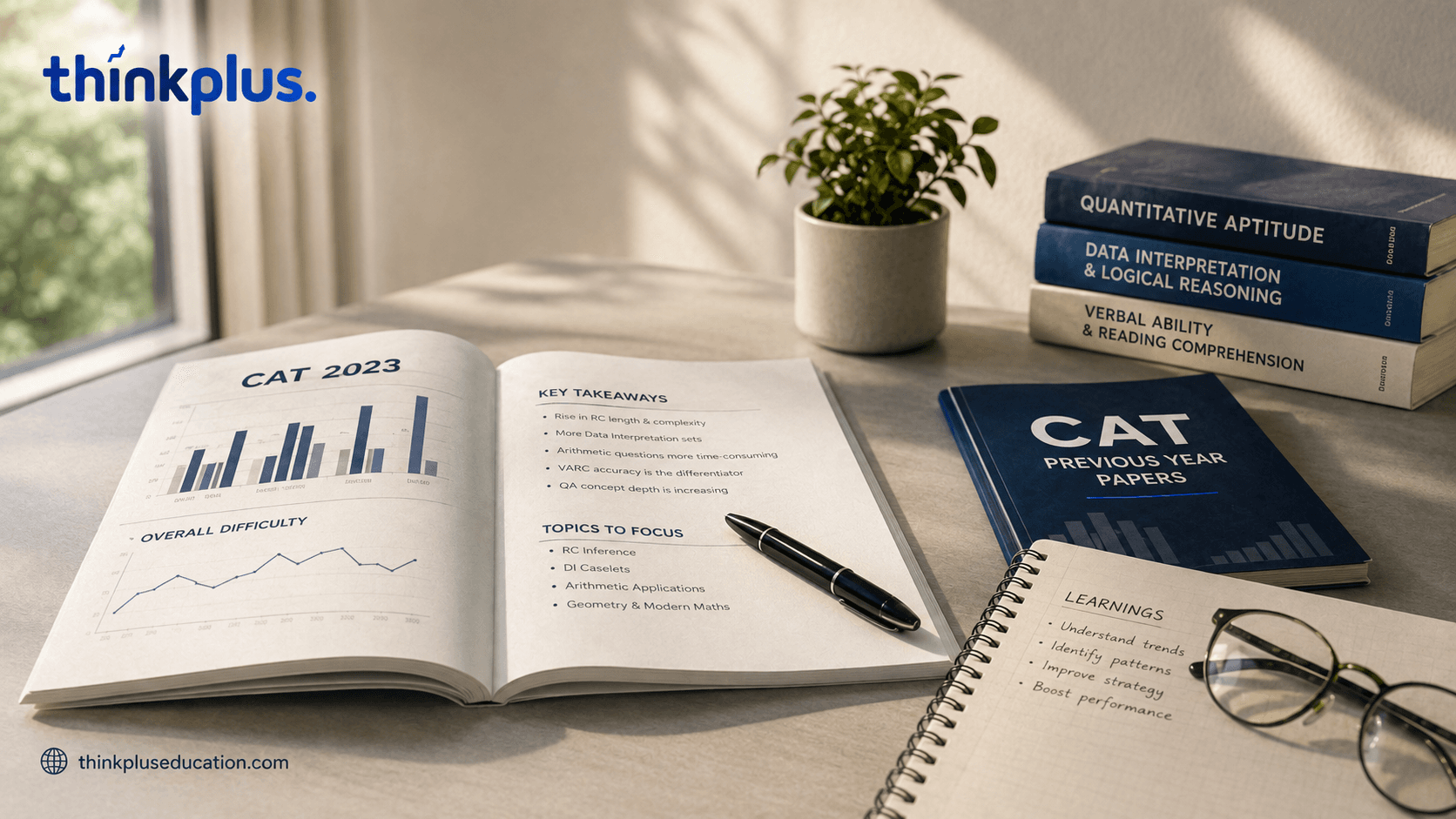
CAT 2023: A REMINDER THAT DIFFICULTY CAN SPIKE
CAT 2023 had 66 questions:
Across expert analyses, the paper was generally considered more difficult than the preceding year, with QA and DILR creating substantial pressure in several slots.
The lesson was clear:
A difficult section must change your attempt strategy, not your confidence.
Students who entered the exam with a fixed attempt target could become frustrated when the paper did not cooperate.
CAT 2024: DILR QUESTION COUNT INCREASED
CAT 2024 moved to 68 questions in many reported analyses:
DILR increased compared with the 20-question structure seen in CAT 2023.
That single change is an important reminder that CAT patterns are not permanent.
Some analyses also described DILR in 2024 as more approachable than in some earlier years.
Lesson:
Never assume that the historically “hardest” section will be the hardest on your exam day.
CAT 2025: SAME BROAD 68-QUESTION STRUCTURE
CAT 2025 again used 68 questions:
IMS's first-take analysis of Slot 1 reported four RC passages in VARC, five DILR sets and 22 QA questions. Other slot analyses described differences in sectional difficulty, with DILR becoming more challenging in some slots.
CAT 2025 also had approximately 2.95 lakh registered eligible candidates and around 2.58 lakh test-takers. Twelve candidates achieved the 100 percentile level in the final result data reported from the CAT authorities.
This competition demonstrates why a small number of avoidable errors can matter at the upper end.
WHAT DO 2023-2025 TEACH US?
TREND 1: THE PAPER STRUCTURE CAN CHANGE
CAT 2023 had 66 questions, while 2024 and 2025 used 68.
Therefore, candidates preparing for CAT 2026 should use the recent structure as a working benchmark, not a promise.
TREND 2: DILR REMAINS UNPREDICTABLE
DILR sets can shift from highly difficult to relatively approachable across years and slots.
Your preparation must focus on:
TREND 3: QA REWARDS BREADTH
Recent QA sections have continued to draw heavily from Arithmetic and Algebra, while Geometry, Number System and other areas remain relevant.
Do not prepare only one topic family.
A broad base gives you more opportunities to identify scoreable questions.
TREND 4: VARC IS NOT JUST ABOUT READING SPEED
Recent papers continue to test subtle comprehension.
An option can appear reasonable but still be unsupported.
The key is: Evidence over intuition.
HOW TO USE PYQs IN THREE STAGES
STAGE 1: TOPIC LEARNING
During early preparation, use selected PYQs to understand how CAT asks questions.
Do not consume entire papers immediately.
STAGE 2: SECTIONAL SIMULATION
Attempt old VARC, DILR or QA sections under 40-minute conditions.
This teaches pacing.
STAGE 3: FULL-PAPER SIMULATION
Closer to CAT, attempt complete papers under realistic exam conditions.
No phone. No pauses. No checking solutions. No extra time.
The simulation is valuable because it trains mental stamina and sectional transitions.
HOW TO ANALYSE A PYQ PAPER
Label questions:
A — Correct and efficient B — Correct but slow C — Wrong due to concept D — Wrong due to carelessness E — Should have skipped F — Could have solved but never reached
Categories E and F often contain the biggest strategic lessons.
If you repeatedly miss easy questions because you spent too much time elsewhere, the problem is not your syllabus.
It is decision-making.
DO NOT MEMORISE “IMPORTANT TOPICS” FROM ONE YEAR
If Arithmetic dominates one slot, students may overreact and ignore Geometry.
If one year has no particular verbal format, students may assume it will never return.
CAT does not owe candidates repetition.
Prepare capabilities, not predictions.
THE BEST PYQ QUESTION TO ASK
After every paper, ask:
If I saw a paper of this difficulty tomorrow, what would I do differently?
That question creates exam readiness.
CONCLUSION
CAT previous-year papers are not crystal balls.
They are training environments.
Recent papers show that:
Use PYQs to develop adaptability.
Do not prepare to repeat the past. Prepare to handle whatever CAT gives you next.
Editorial Reference Basis: Recent CAT 2023, CAT 2024 and CAT 2025 analyses; CAT 2025 participation/result statistics reported from CAT authority communications.
Talk to a Thinkplus counsellor and turn this article into a realistic preparation plan.