Why PYQs Matter
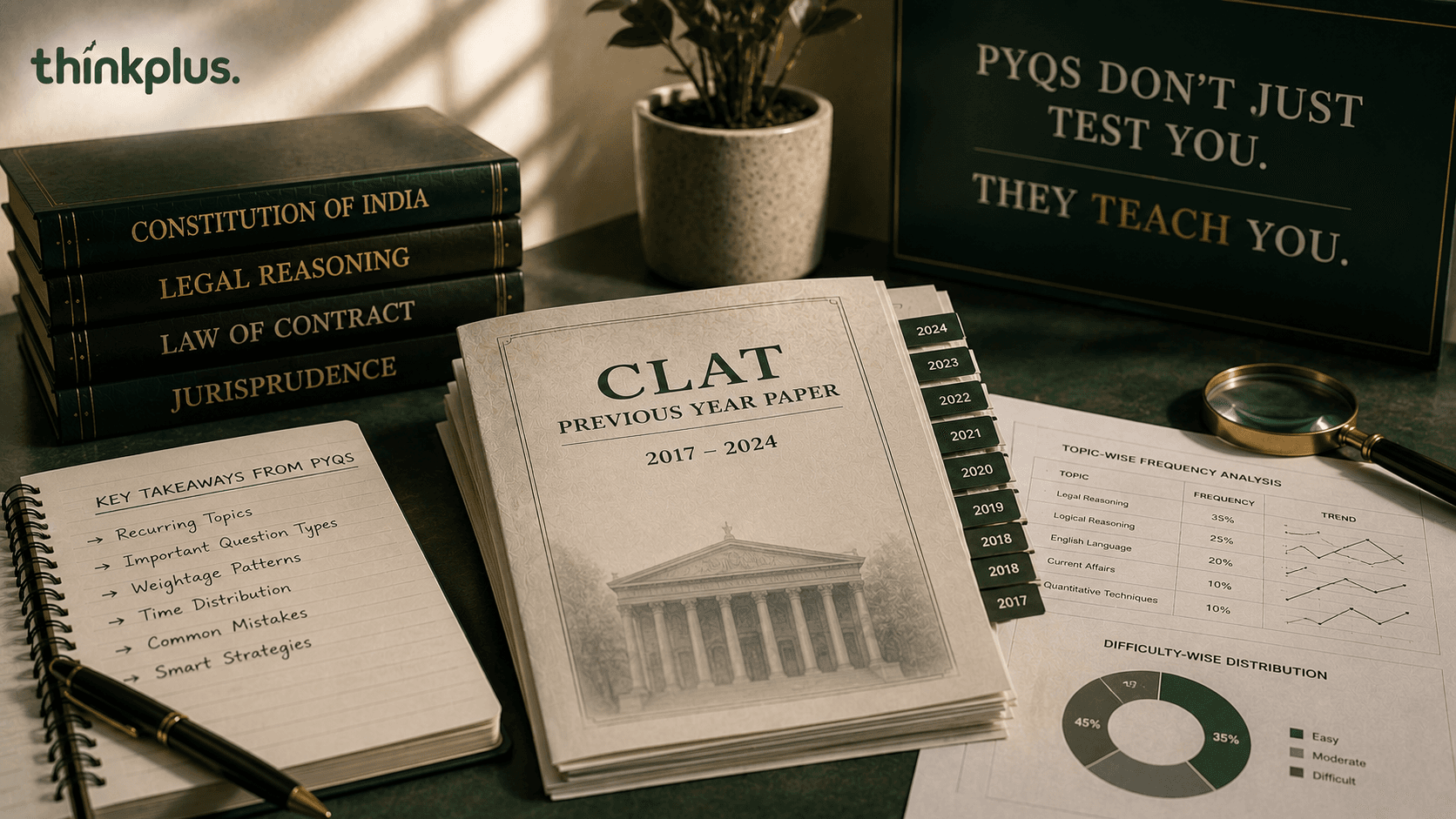
Previous-year CLAT papers provide something textbooks cannot:
Evidence of how the exam actually asks questions.
They show:
• Passage length • Reasoning depth • Question framing • Topic combinations • Time pressure • Difficulty variation
Analyse, Don't Just Solve
When attempting a PYQ, classify each question.
Category A
Correct and quick.
Category B
Correct but slow.
Category C
Wrong because of concept.
Category D
Wrong because you misread.
Category E
Wrong because you guessed.
Category F
Easy question left unattempted.
Categories B, D, E and F often reveal more than the raw score.
Analyse Section-Wise
For English, check:
• Main idea • Inference • Vocabulary • Tone
For Legal:
• Principle identification • Application • Fact distinction
For Logical:
• Premise • Conclusion • Strengthen/weaken • Inference
For Quant:
• Calculation • Interpretation • Arithmetic fundamentals
Use PYQs in Three Stages
Early Preparation
Use questions topic-wise.
Middle Preparation
Attempt sections under time pressure.
Final Preparation
Attempt complete papers in realistic conditions.
Don't Predict the Next Paper Too Aggressively
Previous papers reveal patterns, but they do not guarantee repetition.
Prepare for skills rather than memorised templates.
Conclusion
The correct question after a PYQ is not:
“What was my score?”
It is:
“What did this paper reveal about my preparation?”
That mindset turns old papers into powerful learning tools.
Talk to a Thinkplus counsellor and turn this article into a realistic preparation plan.