Introduction
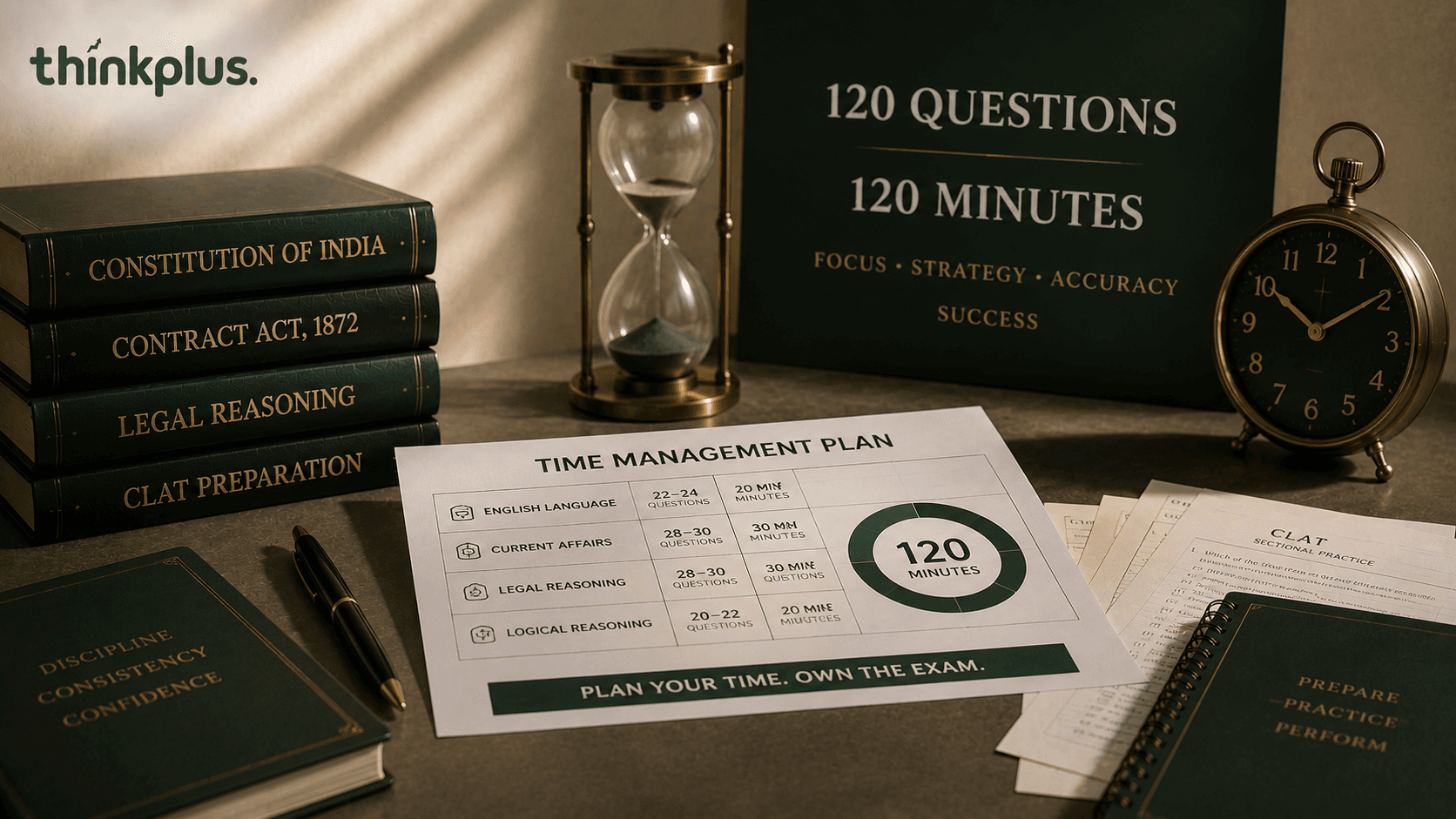
CLAT 2027 gives candidates two hours for 120 questions.
This does not literally mean every question deserves exactly one minute.
Some questions may take 20 seconds.
Some passages may require several minutes.
Therefore, successful CLAT time management is really about resource allocation.
Don't Attempt the Paper Sequentially Without a Plan
Students often begin at Question 1 and continue mechanically.
A better strategy is to determine your preferred section order through mocks.
One student may perform best with:
English → Legal → Logical → GK → Quant
Another may prefer:
GK → Legal → English → Logical → Quant
There is no universal perfect order.
Suggested Time Framework
A starting framework could be:
• Current Affairs: 10–15 minutes • English: 20–25 minutes • Legal Reasoning: 30–35 minutes • Logical Reasoning: 20–25 minutes • Quantitative Techniques: 10–15 minutes • Buffer/review: remaining time
This is not an official allocation. It should be personalised through mock testing.
Use a Skip Rule
One difficult question should never consume time that could solve three easier ones.
If you cannot identify a clear approach after reasonable effort:
Skip → Continue → Return Later
Skipping is not failure.
It is strategy.
Negative Marking Changes Everything
CLAT deducts 0.25 marks for every incorrect response.
Therefore, attempts should be intelligent.
Avoid blind guessing simply because a few minutes remain.
Current Affairs Should Be Fast
If you know the answer, respond.
If you genuinely do not know and cannot derive it from the passage, prolonged thinking will rarely produce new knowledge.
Save that time for Legal or Logical Reasoning.
Reading Sections Need Controlled Speed
Do not read so quickly that you repeatedly return to the passage.
Effective reading means knowing:
What is being discussed? What is the argument? Where did the author's position change?
Comprehension prevents rereading.
Conclusion
The best CLAT time management strategy is not “solve faster.”
It is:
Choose Faster. Skip Faster. Read Better. Decide Better.
Practise this repeatedly in mocks until time management becomes automatic.
Talk to a Thinkplus counsellor and turn this article into a realistic preparation plan.