Preparing for the IPMAT exam is not only about studying harder—it is about studying smarter. Many students spend months on IPMAT preparation, complete hundreds of questions, and attempt multiple mock tests, yet still struggle to improve their scores.
The reason is often simple: a few avoidable mistakes repeatedly affect their accuracy, speed, time management, and overall IPMAT percentile.
If you are preparing for IPMAT Indore, IPMAT Rohtak, JIPMAT, or other management entrance exams after Class 12, avoiding these five common mistakes can significantly improve your performance.
One of the biggest mistakes students make during IPMAT preparation is attempting mock test after mock test without properly analyzing their performance.
Taking an IPMAT mock test tells you your score. Analyzing that mock tells you how to improve your score.
After every mock test, review your mistakes carefully and ask yourself:
Create a simple mock analysis and error log and record recurring mistakes. Over time, you will begin to identify clear patterns in your performance.
For example, you may discover that you are losing marks because of calculation errors in Quantitative Ability or spending too much time on difficult Reading Comprehension passages.
A well-analyzed mock test can therefore be far more valuable than attempting several mocks without reviewing them.
IPMAT Preparation Tip: Spend meaningful time reviewing every mock and convert every mistake into an improvement point for your next test.
Many IPMAT aspirants focus heavily on Quantitative Ability preparation and assume that the Verbal Ability section will automatically be easy.
That can be a costly mistake.
The IPMAT Verbal Ability preparation process requires consistent practice in areas such as:
Some IPMAT Reading Comprehension passages can contain unfamiliar vocabulary, dense arguments, or complex ideas. Spending too much time trying to understand one difficult passage may reduce the time available for easier and more scoring questions.
The key is intelligent question selection.
If a passage appears extremely difficult or time-consuming, move ahead and attempt questions where your chances of scoring are higher. You can always return to the passage later if time permits.
Remember: the goal of the IPMAT exam is not to attempt every question. The goal is to maximize your overall score while maintaining accuracy and managing sectional requirements effectively.
Strong IPMAT preparation should therefore give balanced attention to both Quantitative Ability and Verbal Ability.
Another common IPMAT mistake is becoming emotionally attached to a difficult question.
You may think:
"I have already spent two minutes on this question, so I should solve it now."
This mindset can damage your score.
In a competitive aptitude exam, the value of a question is not determined by how difficult it is. A difficult question and an easier question may contribute similarly to your score, but the easier question may take significantly less time.
If a question is taking too long, mark it for review and move ahead.
Your first priority should be to identify and solve:
This approach improves IPMAT time management, increases attempts, and reduces unnecessary pressure.
Successful test-taking is not about proving that you can solve the hardest question. It is about choosing the right questions at the right time.
Rough work is necessary during the IPMAT Quantitative Ability section, but excessive writing can silently consume valuable exam time.
Many students write complete equations, lengthy calculations, unnecessary steps, and repeated information on their rough sheets.
Instead, train yourself to use short and organized rough work.
Write only:
Improve your familiarity with mental calculations, approximation techniques, arithmetic shortcuts, percentage calculations, ratios, multiplication techniques, and number properties.
This does not mean skipping important working steps. The goal is to eliminate unnecessary writing while maintaining accuracy.
During your IPMAT preparation, practice solving questions with compact rough work so that this habit becomes natural before the actual exam.
Better rough-sheet management can improve both speed and question-solving efficiency.
Random guessing can quickly reduce an otherwise strong IPMAT score.
Students sometimes select an option because:
"This answer looks more likely."
or
"I have already eliminated one option, so I might as well guess."
This approach can be risky when negative marking applies.
A few unnecessary incorrect attempts can reduce your overall score and may also affect your ability to clear the required cutoff.
Instead of random guessing, use a calculated approach.
Attempt a question when:
Avoid answering purely because an option "feels right."
Accuracy is extremely important in competitive exams. Sometimes leaving an uncertain question unanswered is strategically better than taking an unnecessary risk.
The goal should not be maximum attempts. It should be maximum effective attempts.
** Final Thoughts: Prepare Smarter for IPMAT **
Cracking IPMAT requires more than completing the syllabus. Your IPMAT preparation strategy should combine strong concepts, consistent practice, mock-test analysis, time management, accuracy, and intelligent question selection.
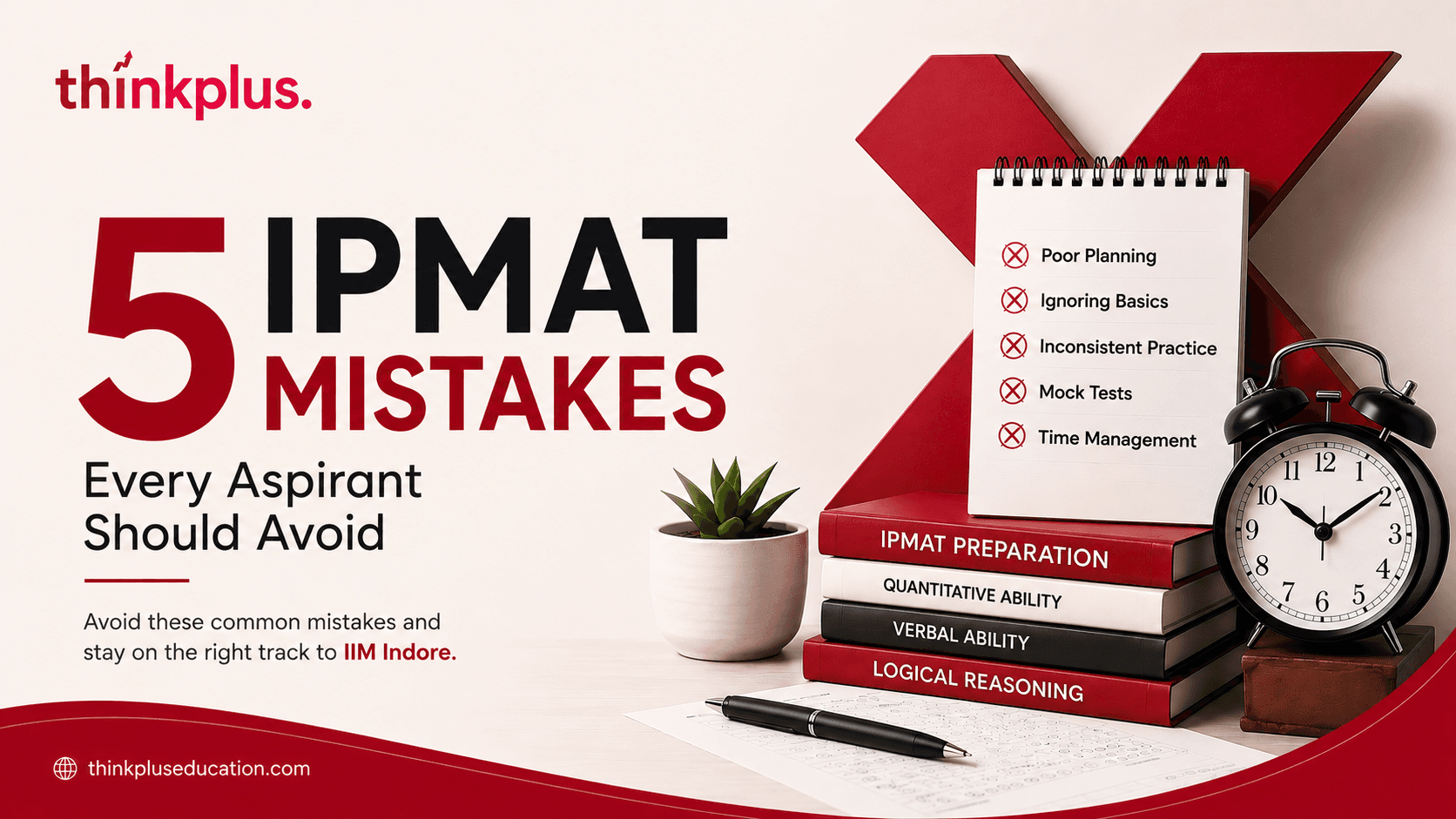
Avoid these five common IPMAT preparation mistakes:
Fixing these habits early can dramatically improve the quality of your preparation.
Every mock test should teach you something. Every mistake should identify an area for improvement. And every practice session should take you one step closer to becoming a smarter and more confident test-taker.
With disciplined preparation, regular IPMAT mock tests, detailed performance analysis, and the right strategy, you can steadily improve your chances of achieving a strong score and moving closer to your goal of securing admission to a leading Integrated Programme in Management (IPM).
Talk to a Thinkplus counsellor and turn this article into a realistic preparation plan.