Introduction
For many Class 11 and 12 students, choosing a career path can feel almost as difficult as preparing for an entrance exam. One common question is:
Should I prepare for IIT or choose IPMAT and pursue management after Class 12?
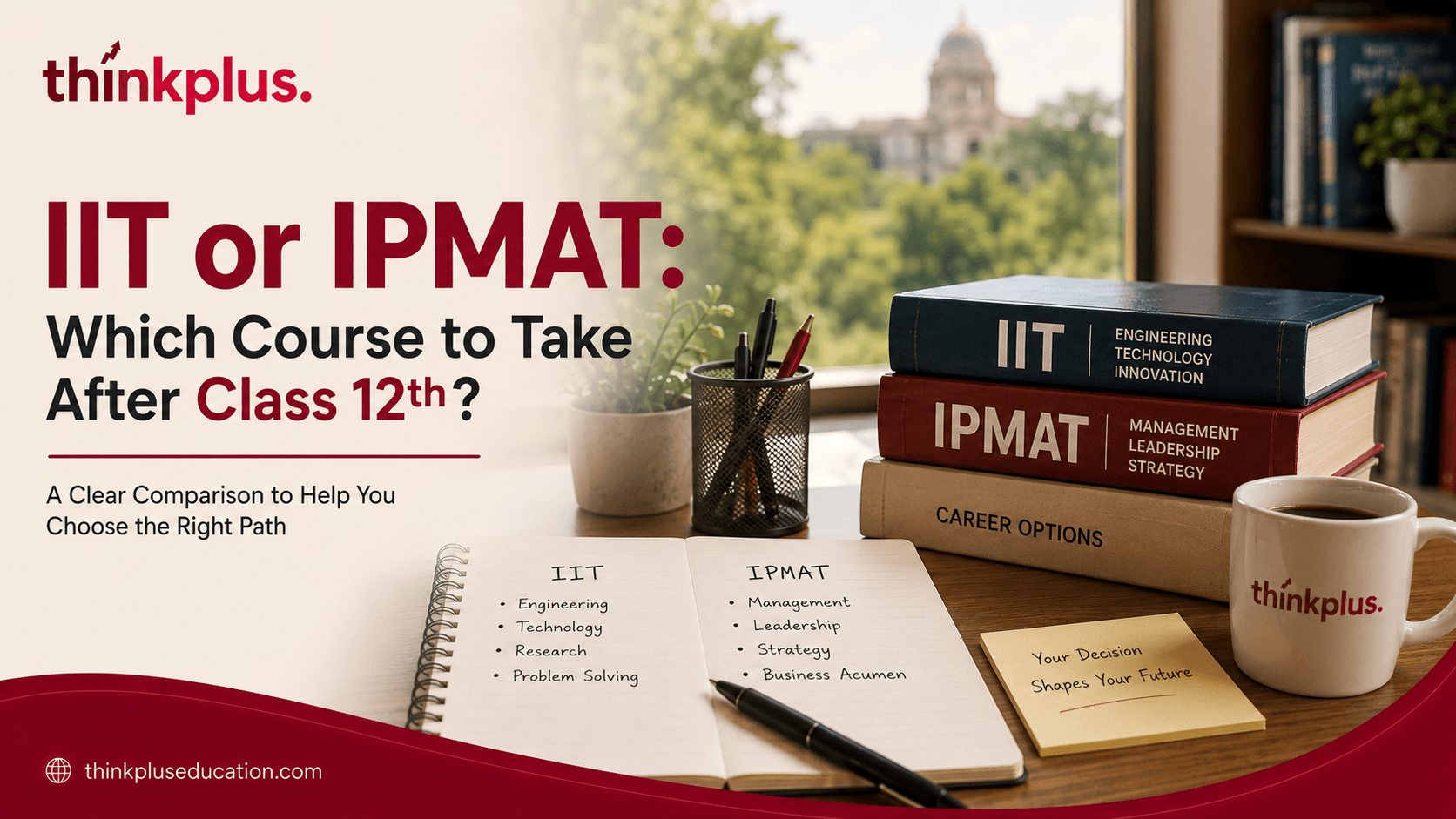
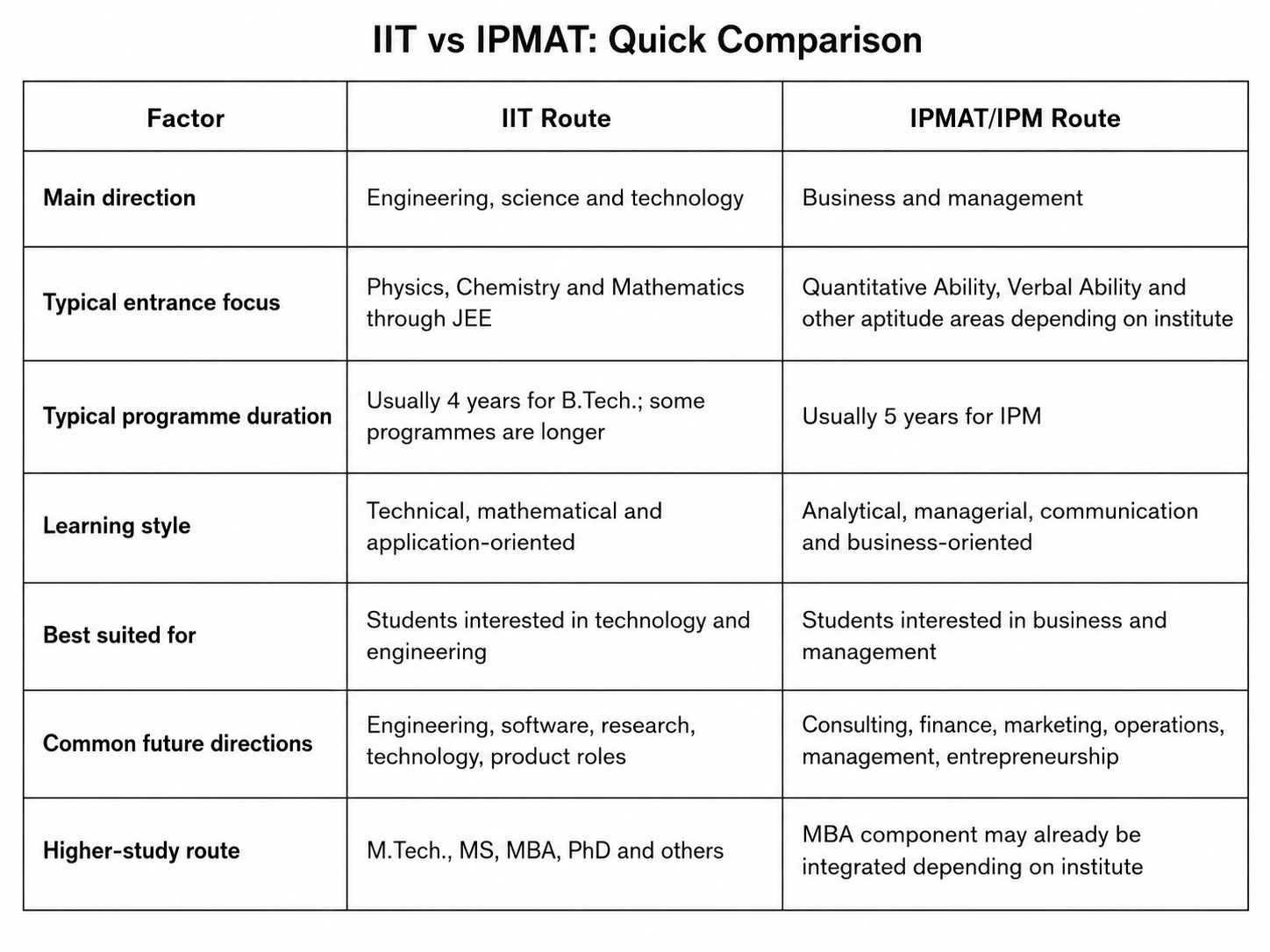
Before comparing them, there is one important clarification. IIT is not a single course, and IPMAT is not a degree. IITs offer undergraduate programmes such as B.Tech., B.S., dual-degree and other programmes, while IPMAT is an entrance examination used for admission to Integrated Programme in Management courses offered by institutions such as IIM Indore and IIM Rohtak. IIT Bombay, for example, offers undergraduate B.Tech., B.S., dual-degree and B.Des. programmes through different admission routes.
Therefore, the real comparison for most students is:
Engineering/technology education at an IIT vs a five-year Integrated Programme in Management at an IIM or another management institute.
Neither path is universally better. The correct choice depends on what you enjoy studying, what type of problems you like solving and what kind of career you want to build.
Understanding the IIT Route
For students targeting the traditional B.Tech. or related programmes at IITs, the journey generally involves JEE Main followed by JEE Advanced.
For admission through JEE Advanced in 2026, Physics, Chemistry and Mathematics were compulsory Class 12 subjects. Candidates also had to satisfy the prescribed board-performance requirement and obtain a JEE Advanced rank before participating in the JoSAA seat-allocation process.
An IIT education is especially suitable for students interested in fields such as:
Engineering, computer science, electronics, mathematics, physics, data science, technology, product development and research.
The learning environment generally involves significant mathematical and analytical thinking, technical problem solving, laboratory or project work, programming or engineering applications depending on the chosen branch.
A student should therefore choose the IIT route because of a genuine interest in technology and problem solving, not merely because “IIT” is a prestigious name.
Understanding the IPMAT Route
IPMAT is designed for students interested in beginning their management education directly after Class 12.
IIM Indore's Integrated Programme in Management is a five-year programme divided into two broad stages. The first three years build foundations through subjects including Mathematics, Statistics, Economics, Psychology, Sociology, Political Science, Humanities and communication. The final two years are at the postgraduate management level, where IPM students study management alongside PGP students.
The management curriculum later includes areas such as finance, marketing, strategy, operations, information systems, economics and organisational behaviour. IIM Indore also includes social and business internships as part of the programme.
On successful completion, IIM Indore currently awards a Bachelor of Arts (Foundations of Management) and Master of Business Administration under its dual-degree structure.
This route is particularly attractive for students interested in business, entrepreneurship, consulting, finance, marketing, leadership and management.
Choose IIT If You Enjoy Technical Problem Solving
The IIT path may suit you better if you genuinely enjoy Physics and Mathematics, like understanding how systems work and are interested in technology.
Ask yourself whether you enjoy solving numerical problems even when there is no exam pressure.
Do topics such as coding, electronics, machines, artificial intelligence, mathematics, energy systems or scientific research excite you?
If yes, engineering could offer the deeper academic fit.
Preparing for IIT only because parents, relatives or friends say that engineering is the “safe option” can become difficult if you dislike the actual subjects involved.
Choose IPMAT If Business Excites You More
IPMAT may be a stronger option if you frequently find yourself interested in questions such as:
Why does one company outperform another? How do businesses make money? How are brands created? How are investments evaluated? How do companies manage people? Why do startups succeed or fail?
Management education involves much more than presentations and communication. The IIM Indore IPM foundation itself contains Mathematics, Statistics, Economics and quantitative subjects, so students should not assume that choosing IPMAT means escaping mathematics.
However, the purpose of the mathematics is different. It supports decision-making, economics, analytics and business problem solving rather than primarily engineering applications.
JEE vs IPMAT: The Preparation Difference
Students considering both examinations should understand that the preparation styles are significantly different.
JEE preparation for the traditional IIT route is heavily centred on Physics, Chemistry and Mathematics and requires deep conceptual mastery of the Class 11-12 science curriculum.
IPMAT preparation typically requires aptitude mathematics, English and other sections depending on the particular examination. IIM Indore's current admission process uses an aptitude test followed by further selection stages for shortlisted candidates.
This means IPMAT aspirants need a combination of mathematical ability, reading ability, speed, accuracy and communication skills.
Can You Prepare for JEE and IPMAT Together?
Yes, some students can, especially those already preparing strongly for JEE.
A serious JEE student may already have a strong mathematical base, which can help with the quantitative side of IPMAT. However, they still need separate preparation for Verbal Ability, reading comprehension and IPMAT-style aptitude questions.
The biggest challenge is time.
Trying to prepare equally for every examination can result in mediocre preparation for all of them. Students should ideally identify a primary career direction and keep the second examination as a realistic alternative rather than constantly switching focus.
Don't Choose Based Only on IIT vs IIM Brand Value
It is tempting to ask:
“Which is more prestigious—IIT or IIM?”
That is usually the wrong question.
You are not choosing a logo for your résumé. You are choosing what you may study intensely for several years and possibly build a career around for decades.
A highly motivated engineering student can perform exceptionally well through the IIT route.
A student who genuinely enjoys business strategy, economics, communication and leadership may thrive far more in an IPM programme.
Career fit matters more than blindly following brand names.
A Simple Decision Test
Imagine two projects.
In the first, you have to build a technology solution, understand how it works, solve technical problems and improve its performance.
In the second, you have to understand customers, analyse a market, design a business model, calculate profitability and develop a strategy for growing a company.
Which project would you voluntarily choose?
Your instinctive answer can reveal more about your interests than dozens of generic career tests.
What If You Like Both Technology and Business?
You do not necessarily have to abandon one permanently.
Many engineers later pursue MBAs and move into product management, consulting, entrepreneurship or business leadership. Similarly, management students increasingly work in technology-driven industries and need strong analytical and digital skills.
The difference is simply where you want to build your foundation first.
Choose engineering first if you want deep technical expertise.
Choose IPM first if you want business and management to become your primary foundation from the beginning.
Final Verdict: IIT or IPMAT?
There is no winner in the IIT vs IPMAT debate.
Choose IIT/JEE if you enjoy Physics, Mathematics, engineering, coding, technology and technical problem solving.
Choose IPMAT/IPM if you enjoy business, economics, strategy, finance, entrepreneurship, communication and leadership.
Do not ask only:
“Which option has better placements?”
Instead ask:
“Which field can I imagine becoming exceptionally good at?”
Because the best career after Class 12 is not necessarily the one that looks most impressive today. It is the one that matches your interests, abilities and long-term ambitions closely enough for you to keep improving long after the entrance examination is over.
Talk to a Thinkplus counsellor and turn this article into a realistic preparation plan.