Why Time Management Matters
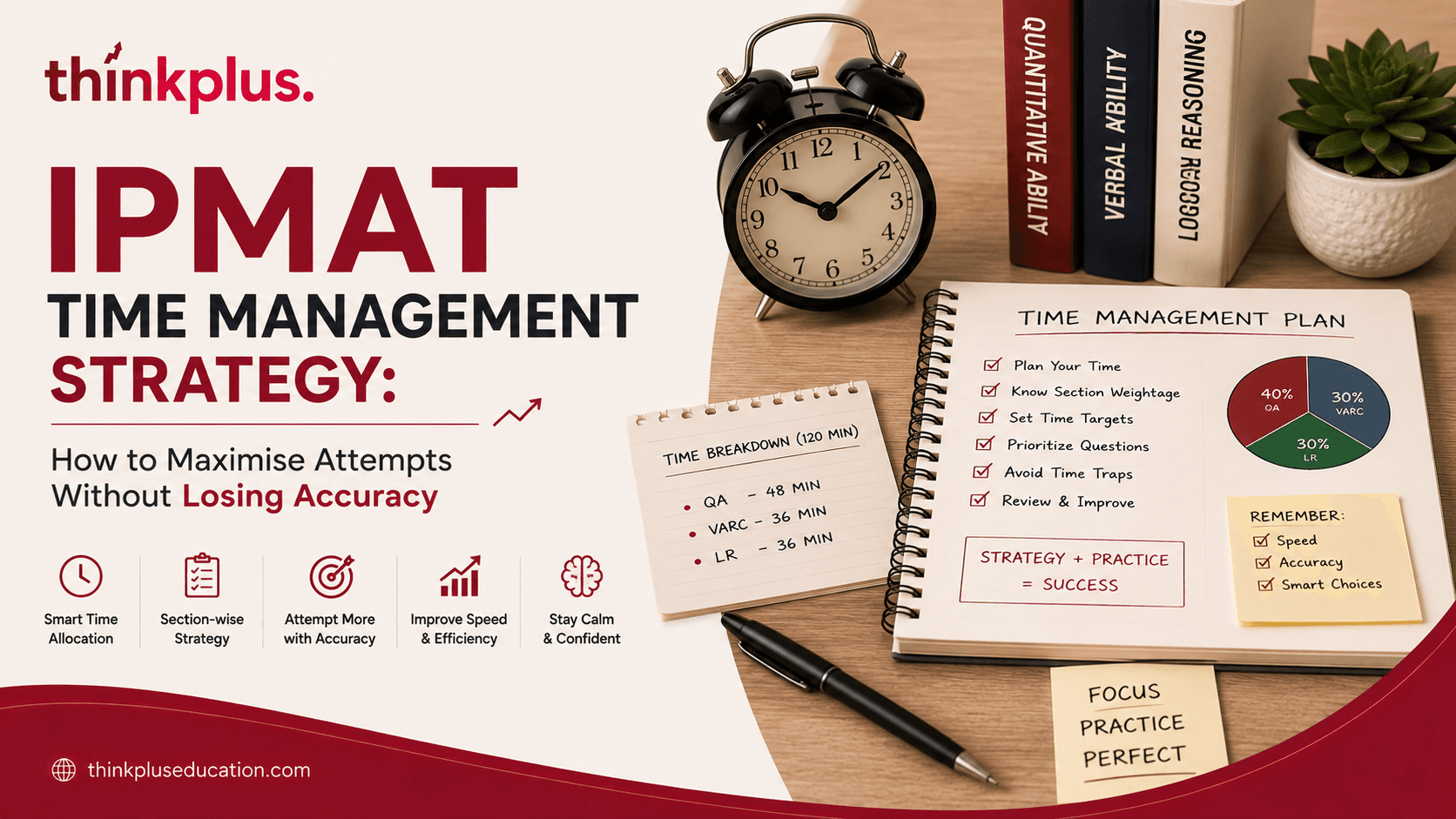
An aptitude examination is not simply a test of whether you can solve a question. It tests whether you can solve the right questions within a limited period. This distinction is particularly important in IPMAT. For IIM Indore's 2026 IPM Aptitude Test, Quantitative Ability-MCQ, Quantitative Ability-Short Answer and Verbal Ability each received a fixed 40-minute window. Candidates were also required to attempt the sections in a pre-specified order. JIPMAT 2026 provided 150 minutes for 100 MCQs across Quantitative Aptitude, DI-LR and VARC. These formats demand slightly different approaches, but the central principle remains the same: do not allow one difficult question to control your examination.
The Three-Round Method A useful approach in sections where navigation permits it is to mentally classify questions into three groups. Round 1: Immediate Solves
Use a Time-Loss Rule Students often waste four or five minutes because they feel, "I have already spent two minutes, so I must finish this." That is sunk-cost thinking. Instead, create a rule before the examination. If you cannot identify a workable direction within a reasonable amount of time, move on. Your precise threshold should be developed through mocks rather than copied from another student.
Accuracy Matters Because of Negative Marking In IIM Indore's latest pattern, incorrect MCQ answers attract a one-mark deduction, while the Short Answer Quant section does not have negative marking. IIM Rohtak's 2026 test likewise applied a one-mark penalty for wrong answers. Attempting more questions is valuable only when additional attempts have reasonable accuracy.
Managing the Quantitative Ability Section Quant questions can create severe time traps.
Managing Verbal Ability Verbal sections create a different problem: candidates often assume every question should be attempted rapidly. Reading comprehension should not be rushed so aggressively that understanding collapses. Read for structure.
Time Management in JIPMAT JIPMAT's 2026 test contained 100 questions in 150 minutes. Because DI and LR may contain sets or multi-step reasoning, students should practise moving away from an unproductive set early. The best way to find your ideal section allocation is through mocks. Try different approaches, record the results and choose the method that gives the highest score-not the method that merely feels comfortable.
The Last Five Minutes
Mock Tests Are Time-Management Laboratories After every mock, calculate: Attempts x accuracy.
Conclusion
Effective IPMAT time management is not about solving everything quickly. It is about directing limited time toward the questions most likely to produce marks. The strongest candidates learn to: Recognise -> Select -> Solve -> Skip -> Reassess. Practise this process repeatedly in timed conditions. By exam day, skipping a difficult question should not feel like defeat-it should feel like a deliberate scoring decision.
Talk to a Thinkplus counsellor and turn this article into a realistic preparation plan.